One Vegetable, a Whole Counter: The Eggplant Dishes at Capo Market
Count the eggplants on this counter at Capo market and you run out of fingers. Stuffed, stacked, sliced, stewed and filled with pasta, nearly every tray up top has one in it. The bottom row is salads and sides, and two of those have eggplant in them too.
The eggplant is usually said to have reached Sicily with the Arabs, and the island never let go of it. Summer is the season, but between greenhouses and the rest of Italy's south, the stalls have it all year.
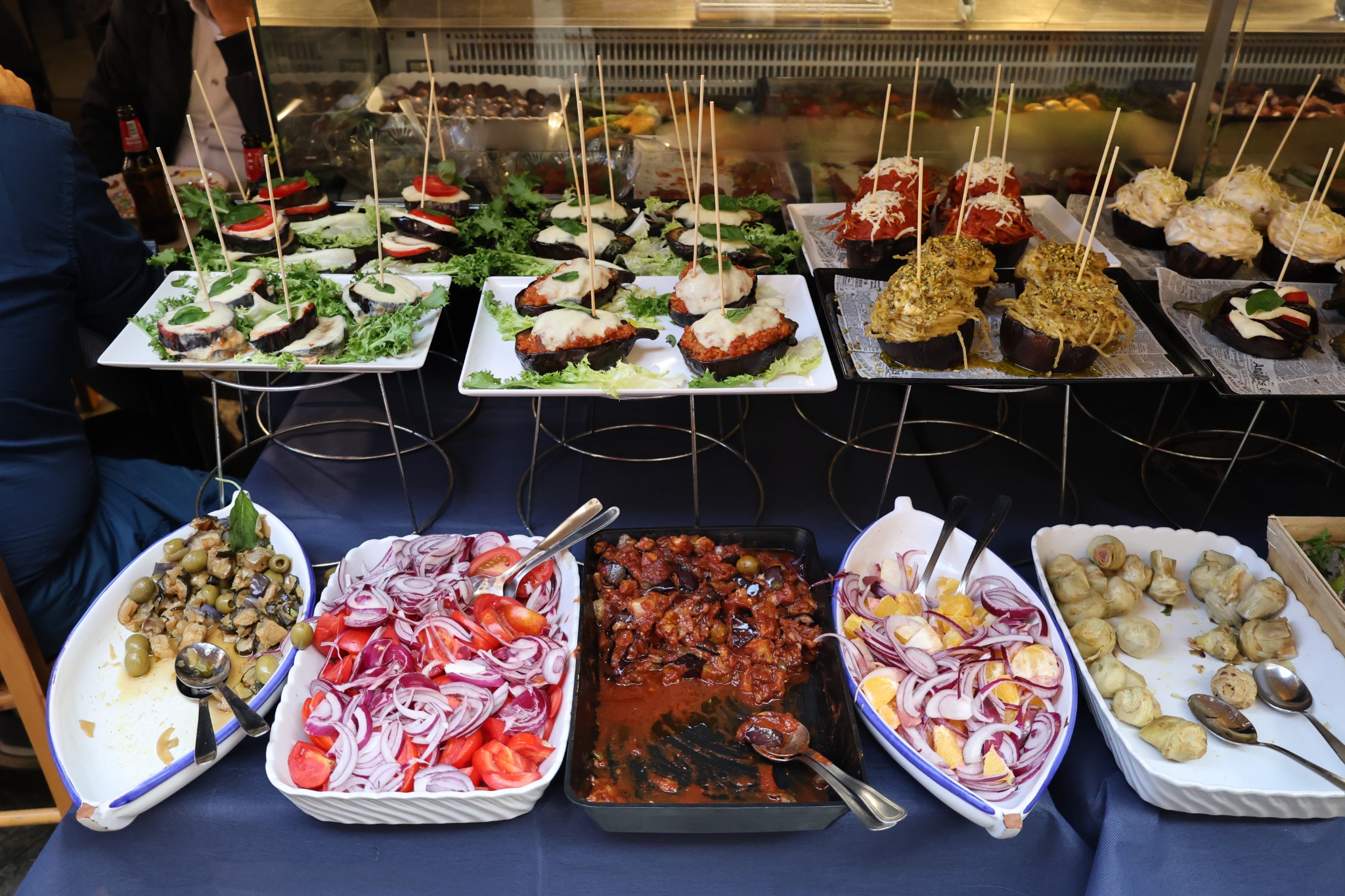
Photo: Media Gallery
The top row, left to right
Eggplant towers. Thick rounds of fried eggplant stacked with mozzarella and a slice of tomato, finished with a basil leaf, held together with a long skewer. A tidy, single-portion take on parmigiana.
Stuffed halves. Eggplant halves topped with tomato sauce and a thick layer of melted cheese, one skewer in each so you can lift them out.
Pasta in the shell. Spaghetti baked into a hollowed half, in tomato or a green pesto crust, the same idea as the stall in pasta baked in an eggplant. Further right, more with a white sauce.
Eggplant rolls. At the far end, thin slices rolled around a filling with a ribbon of white sauce and a basil leaf.
The bottom row
Olives and eggplant cubes. A boat-shaped dish of green olives tossed with chunks of eggplant and herbs.
Onion and tomato salad. Thinly sliced red onion and tomato wedges. In Palermo the red onions are sweet enough to eat raw like this.
Caponata. The dark tray in the middle. Fried eggplant cubes stewed with celery, onion, olives, capers, tomato, vinegar and sugar until it turns glossy and sweet-sour. It's served at room temperature and tastes better the day after.
Onion, orange and egg. A second boat with red onion, orange segments and what looks like boiled egg.
Artichokes. Small whole artichokes, cooked and dressed, at the end of the row.
Caponata, briefly
If you only eat one eggplant dish in Palermo, make it caponata. Every family has its version. Some add pine nuts and raisins, some add almonds, some a little cocoa. In Palermo it's usually made with celery and plenty of vinegar; in the east of the island bell peppers often go in. Everyone agrees the eggplant has to be fried, not baked, and that the dish needs to rest.
Parmigiana, briefly
Parmigiana di melanzane: layers of fried eggplant, tomato sauce, basil, cheese, baked until it sets. Despite the name, many food historians tie it to Sicily or Naples. The word may come from the Sicilian parmiciana, the slats of a shutter, which the overlapping slices resemble. That story is popular in Sicily and disputed elsewhere. Either way, the towers on this counter are the same flavours in a more portable shape.
Ordering
Pick two or three things and ask for a mixed plate, un piatto misto. The salads are priced by weight or by the portion; the skewered pieces by the piece. Ask before they plate it.
Pair it with something from the seafood stalls next door, and you have the full Capo lunch: one plate of vegetables, one of fish.
At home: the towers are easy. Slice an eggplant into rounds 1.5 cm thick, salt them for 30 minutes, pat dry and fry in olive oil until golden. Stack each round with a slice of mozzarella, a slice of tomato and a spoon of tomato sauce, three layers high. Bake at 200°C for 10 minutes until the cheese melts. Basil on top.