Caramelle Pasta: Filled Pasta Twisted Like Wrapped Sweets
From across the room they look like sweets. Little parcels with a fat middle and two pinched ends, lying in rows on a floured counter. Get closer and you see they're pasta, filled and twisted like the paper on a hard candy. That's exactly where the name comes from. Caramelle means sweets.
Behind the glass
In an open kitchen behind a glass screen, two cooks are working. One, in a black cap and white jacket, presses a mound of yellow filling together in a big plastic tub with gloved hands. The other stands by a green basin on a scale. On the counter in front of the glass, rows of caramelle: deep pink in the middle, pale yellow at the twisted ends. Two steel trays to the left are piled high with more.
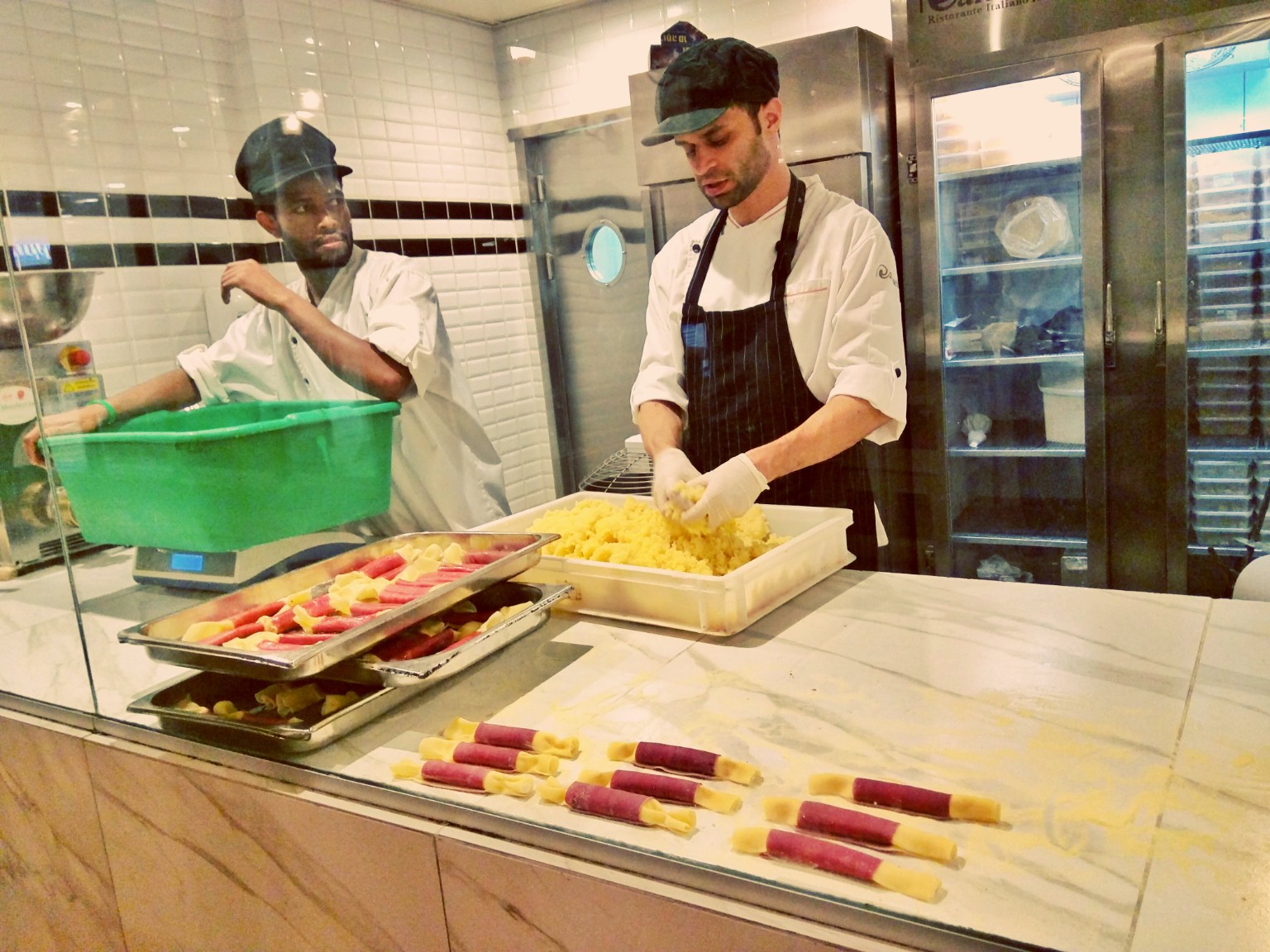
Photo: Peppers
The two colours are the trick. The pink is a sheet of coloured pasta (often beetroot), laid in a band across plain egg pasta before the parcels are cut and rolled. Twist the ends, and the pink stays in the middle like the wrapper's printed label.
The kitchen in the photo isn't named, and it doesn't need to be. Restaurants all over the world make caramelle now. Their home is northern Italy.
Where they come from
Caramelle belong to Emilia-Romagna's long family of filled pasta. Around Piacenza the classic is tortelli con la coda, "tortelli with a tail", a pasta braided along the top with one twisted end. The town of Vigolzone claims they were first made in its castle in 1351, for a visit by the poet Petrarch. A close cousin twists both ends, and that's the shape most people call caramelle. Parma and Piacenza both make them.
The traditional filling is ricotta, Parmigiano and spinach or chard, with a little nutmeg. Restaurants play with it: pumpkin in autumn, mushrooms, burrata, beetroot.
How they're served
Like most delicate filled pasta in Emilia, caramelle get a light sauce so the filling does the talking:
- melted butter and sage, with grated Parmigiano
- butter and a little tomato
- a light cream sauce in winter
Heavy ragù would crush them.
How to buy and cook them
- Fresh pasta shops and good delis sell caramelle by weight. Plan on about 150 grams a person for a main course.
- Cook in plenty of salted water at a gentle boil, not a rolling one, or the twisted ends split. They're done 2 to 4 minutes after they float.
- Lift them out with a slotted spoon rather than tipping them into a colander.
Recipe: ricotta and spinach caramelle
Serves 4.
Pasta: 300 g "00" flour, 3 eggs. For two-colour pasta, make a second, smaller dough with 100 g flour, 1 egg and 1 tablespoon beetroot powder or a little strained beetroot juice.
Filling: 250 g ricotta, drained; 200 g spinach, cooked, squeezed very dry and chopped; 60 g grated Parmigiano; 1 egg yolk; nutmeg, salt and pepper.
Sauce: 80 g butter, a handful of sage leaves, more Parmigiano.
- Make the dough(s), knead until smooth, wrap and rest 30 minutes.
- Mix the filling and keep it cold.
- Roll the plain dough thin. For two colours, roll the pink dough just as thin, cut it in a strip and lay it across the middle of the plain sheet, then run both through the machine once more to fuse them.
- Cut rectangles about 6 × 8 cm. Put a teaspoon of filling in the centre, roll up into a tube, and twist each end firmly in opposite directions.
- Cook in gently boiling salted water. Meanwhile melt the butter with the sage until it foams and smells nutty.
- Toss the caramelle in the butter and finish with Parmigiano.
For the pasta of the south, see pasta in Palermo. The photo also appears on Peppers.