How to Read a Fish Stall at Capo Market in Palermo: Swordfish, Calamari and the Price Cards
A fish stall at Capo market is a small theatre. Everything is on ice, tilted toward you, decorated with lemon halves and cherry tomatoes. The fishmonger stands behind it with a knife and a scale. And it's all priced in a way that makes sense once you know how to read it.
This is one stall on a grey morning, under a red awning at the edge of the market. Behind it, a lane with fairy lights strung overhead and tables where people were already sitting down to eat.
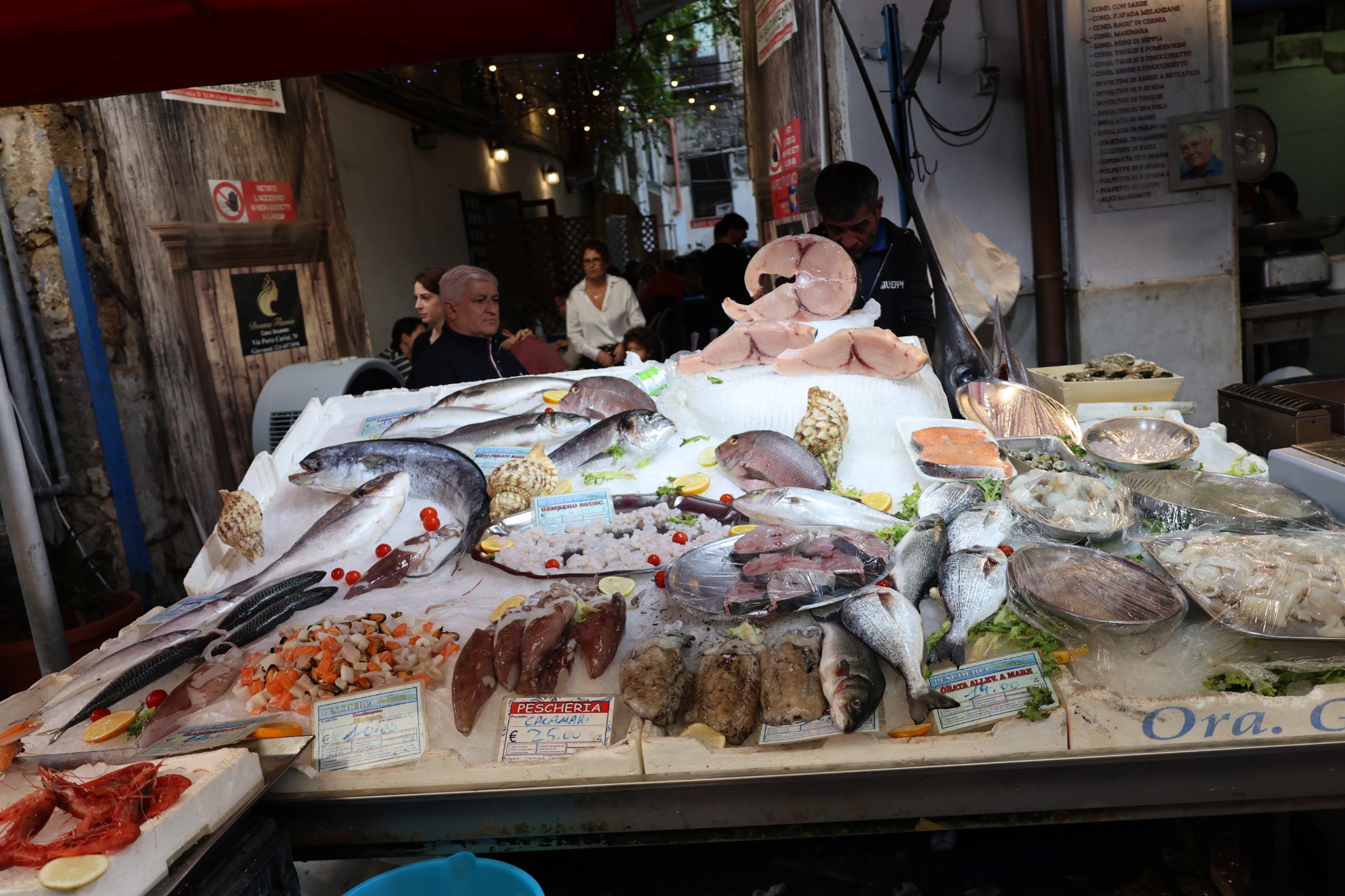
Photo: Media Gallery
What's on the ice
Swordfish. The centrepiece, as it often is in Palermo. A big round cross-section stands upright at the back, with thick steaks cut and fanned out in front of it. The sword itself pokes up on the right, so you know what you're buying.
Sea bream. Several whole orate, silver with a gold band between the eyes.
Calamari and cuttlefish. A row of squid, purple-pink and glossy. Next to them, cuttlefish, the stubbier ones with the speckled skin.
Red prawns. A box of them at the front left, the deep red Sicilian kind.
There's more: mackerel, a tray of chopped mixed seafood for sauce, salmon fillet, peeled prawns, a bowl of oysters at the back, sea snails used as decoration.
Reading the cards
The handwritten cards say "Pescheria" at the top, then the fish, then a price. Fish in Italy is priced by the kilo unless the card says otherwise.
On this stall that day: calamari at €25 a kilo. Sea bream at €14 a kilo, with the label "orata allev. a mare". That abbreviation matters. Allevata means farmed, a mare means in sea cages. Wild bream would say pescata or selvaggia and would cost a lot more. Italian law requires the label to say whether fish is wild or farmed, and where it comes from, so look for it.
Other useful words:
- Decongelato: previously frozen. Not bad, just not fresh, and it should be cheaper.
- Nostrale or locale: local catch.
- Pulito: cleaned. Some stalls charge more for cleaned squid, and some do it for free.
The plaque on the wall
Behind the counter, a marble plaque lists what the stall makes, next to a framed photo of an older man in a blue shirt. The first block is condimenti, ready-made pasta sauces: with sardines, swordfish and eggplant, grouper ragù, marinara, cuttlefish ink, red mullet with cherry tomatoes, red mullet with wild fennel, sardines with wild fennel. Then the involtini: sardines a beccafico, swordfish, red mullet, scabbardfish. Then seafood salad, octopus salad, prawn cocktail, swordfish caponata, swordfish meatballs, sardine meatballs and marinated anchovies.
So this stall also cooks. Buy the fish raw, take a tub of sauce home for your pasta, or have lunch made and eat it at the tables in the lane.
That's common at Capo. More on what the cooking stalls make in red prawns, octopus and clams at a Capo seafood stall, and the stuffed sardines on that plaque have their own post: sarde a beccafico.
When swordfish is in season
Swordfish fishing in the Mediterranean closes for the first three months of the year and reopens on April 1. The famous harpoon fishing in the Strait of Messina, from tall boats called feluche, runs from spring into late summer. So a whole swordfish on the ice in November is normal, and fresh swordfish in February should make you ask questions.
Buying tips
- Ask for half a kilo, mezzo chilo, or a number of pieces. They'll weigh it in front of you.
- Swordfish steaks are cut to order. Say how thick: una fetta di due dita, a slice two fingers thick, is the usual for grilling.
- If you're staying somewhere with a kitchen, ask them to clean and fillet. Most will.